• Pacific Institute for Research and Evaluation

Prevention Research Center

  • About PRC
    • Mission
    • Staff
    • Scientific Advisory Council
    • Emeriti
    • Historical Overview
    • PIRE California
  • Research
    • Research Projects
    • The Center Grant
    • Publications
    • Posters and Presentations
  • Policy Studies
    • Minimum Legal Drinking Age
    • State Alcohol Controls
    • Retail Availability of Alcohol
    • Regulating Youth Access to Alcohol
    • Smokefree Bar Policy Compliance
    • Regulating Youth Access to Tobacco
    • Legalization of Marijuana
    • Role of School-Based Health Centers
  • Community Action
    • Media Releases
    • Downloadable Resources
    • Strategies
    • Useful Links
You are here: Home / Research / The Center Grant / Post-Legalization Regulatory Policies, Alcohol and Cannabis Co-Use, and Consequences Among Non-Hispanic Whites and Hispanics in California

Post-Legalization Regulatory Policies, Alcohol and Cannabis Co-Use, and Consequences Among Non-Hispanic Whites and Hispanics in California

Component Directors: Raul Caetano, M.D., Ph.D. and Patrice Vaeth, Dr.P.H.

The 2016 legalization of recreational cannabis in California created a legal growth, distribution, sales, and taxation system, which is still going through an implementation process dependent on local policy options.

Presently, there is considerable local variation in cannabis policies, along with legal retail availability and illegal trafficking throughout the state. This 5-year component of the Center will leverage these unique varying community contexts to examine the associations between local alcohol and cannabis control policies, alcohol and cannabis co-use and related problems among non-Hispanic Whites and Hispanics. In 2018, these two groups together comprised 76% of the population in California. 
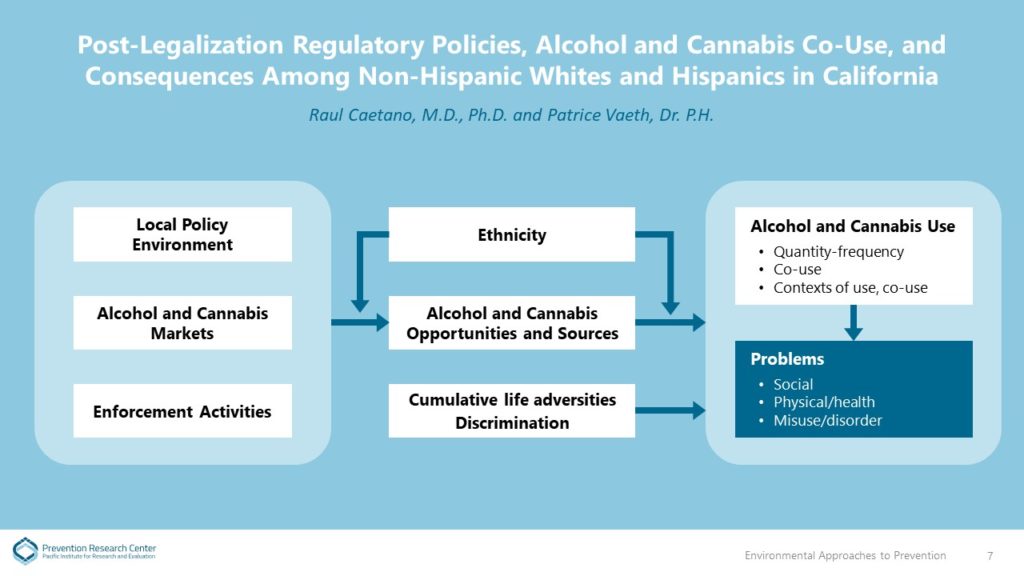
Ethnicity, cannabis and alcohol concurrent use and environments

The study will be the first to investigate how the local policy and retail environment (and the illegal cannabis market) contribute to or possibly ameliorate ethnic disparities in alcohol and cannabis use and related harms with longitudinal analyses of survey data. The study will also focus on ethnic differences in exposure to both the legal and illegal cannabis market, and how that may affect risks related to alcohol and marijuana use and co-use in different contexts.

This study will determine whether and how these differences contribute to ethnic disparities in problems related to alcohol and cannabis use, along with cumulative life adversities and discrimination.

Research Plan

Survey data will be collected over the phone and online from 18-39 year old Whites and Hispanics in years 1, 2, and 3 (T1, T2, T3) of the project (N=1,200) in 40 cities that vary in alcohol and cannabis policies and retail availability. The specific aims are: 1) examine the associations between local regulatory policies, enforcement activities, proximity, and daily exposure to licensed alcohol and cannabis outlets, and illegal cannabis sources; 2) examine the associations between increased exposure to both legal (alcohol and cannabis outlets) and illegal cannabis markets and patterns of use, co-use, and associated problems; 3) examine contexts of alcohol and cannabis use and co-use, variation in types of cannabis use (e.g., smoke, vape, edible) and co-use by contexts, and the association of contexts and types of use and problems; 4) investigate T1 to T3 changes in local policy, policy enforcement and alcohol and cannabis retail availability and T1 to T3 changes (increase, decrease, incidence, stability, cessation) in alcohol and cannabis co-use.

The Center Grant

  • Nighttime Drinking Contexts and Risks in Young Adult Drinkers Before and After Legal Drinking Age
  • Local Alcohol and Marijuana Policies, Retail Availability, and Co-Use During Adolescence and Early Adulthood
  • Post-Legalization Regulatory Policies, Alcohol and Cannabis Co-Use, and Consequences Among Non-Hispanic Whites and Hispanics in California
  • Transitions and Alcohol Use in the Later Lifespan: Environmental and Individual-level influences
  • Community Alcohol Sales and Related Problems: Filling the Critical Research Gap
  • Information and Dissemination in Support of Community Interventions

Ask an Expert

Contact

center@prev.org
Prevention Research Center
2030 Addison St.
Suite 410
Berkeley, CA 94704-2642
Tel: (510) 486-1111

PRC Highlights

Pacific Institute for Research & Evaluation

PRC is a center within the Pacific Institute for Research & Evaluation (PIRE), an independent, nonprofit organization merging scientific knowledge and proven practice to create solutions that improve the health, safety and well-being of individuals, communities, and nations around the world.

Resource Link for Community Action

Resource Link for Community Action provides information and practical guidance that communities can use to prevent alcohol and other drug misuse.

For more information, contact Sue Thomas.

Copyright © 2026 · Prevention Research Center · Website: Amanda McCoy · Log in

Prevention Research Center is a center of Pacific Institute for Research and Evaluation. Visit the main PIRE website at: https://www.pire.org